
When Tim Connelly extended the Minnesota Timberwolves’ open two-way roster spot to Bones Hyland last February, it appeared that it was going to be Hyland’s final chance at sticking in the NBA.
Bones Hyland’s opportunity with Minnesota has ultimately lit a fire under him. Hyland is hungry and has shown the willingness to earn his minutes under Chris Finch. With his scoring prowess, he has begun to stand out among his counterparts in the guard room.
The only significant unknown with Hyland is how he will perform in a larger sample size. He has shown he can play spot minutes for the Timberwolves. However, Hyland must exorcise some of his past demons to secure his spot in a winning rotation.
Tim Connelly drafted Bones Hyland 26th overall in 2021 when he was the Denver Nuggets’ general manager. Early in his NBA career, Hyland showed promise as a spark-plug bench scorer. Hyland averaged 10.1 points per game in his rookie season in Denver, playing 19 minutes per game in 69 games.
Hyland’s loose, free-spirited bucket-getting play style has a ceiling. Still, it looked like he could easily be a player the team could rely on to come off the bench and fit synergistically with Nikola Jokić for years to come.
However, in a quick turn of events, reality shifted in Hyland’s second season.
Despite averaging 12.1 points per game in 19.5 minutes per game, Hyland could not find a consistent fit in Denver’s rotation. It became clear that there was turmoil behind the scenes between Hyland, former head coach Michael Malone, and his Nuggets teammates.
Hyland was not playing defense to Malone’s standards and was unhappy with his lack of opportunities. The nail in the coffin was when he walked off the bench amidst a blowout loss. The quick turn of events rapidly soured Hyland’s relationship with the organization and put his future at risk.
As a result, Denver traded Bones Hyland to the LA Clippers in a four-team deal that sent Thomas Bryant back to the Nuggets.
The Nuggets seldom used Bryant during their title-winning run. Still, the trade and the dialogue surrounding Hyland after GM Calvin Booth‘s quick decision to part ways with the prior first-round selection – only 1.5 seasons after the Nuggets selected him – showcased the complications at play with Hyland.
Much of the story is still hearsay. Still, the Nuggets never gave Hyland a championship ring, which provides enough context.
Hyland was able to play in spurts with the Clippers, but he didn’t recapture the early flashes of promise he showed in Denver during his rookie season.
After being in and out of the rotation in Los Angeles, the Clippers traded Hyland at the 2023 deadline, just two years after Denver had traded him. The Clippers moved Hyland and Terance Mann to the Atlanta Hawks for Bogdan Bogdanović. Once the league approved the trade, Atlanta released Hyland.
Hyland was back at square one, but Tim Connelly met him there just three weeks later.
When Hyland arrived in Minnesota in late February, the Timberwolves were in the middle of a playoff push. Hyland saw play in just four games, totaling 17 minutes, with most of it in garbage time.
Hyland received playing time with the Iowa Wolves, where he averaged 33.5 points per game in two games. Still, Hyland did not spend enough time in the organization to clarify whether he’d remain with the Wolves this season.
The best argument for Hyland’s eventual return was that the Timberwolves were going to need another guard to compete for minutes after Nickeil Alexander-Walker signed with Atlanta in free agency.
The Timberwolves kept their final roster spot open through the entire summer. Despite Hyland reportedly receiving interest from EuroLeague and Adriatic League side Red Star Belgrade, Hyland returned to the Timberwolves in September on a one-year $2.5 million deal.
Hyland would have to prove himself as a winning player to crack Minnesota’s rotation, which has deep playoff aspirations. However, Minnesota’s convoluted point guard issues created an opportunity for him.
A strong preseason demonstrated that Bones Hyland could easily compete with Mike Conley and Rob Dillingham for minutes, and that has continued into the middle of this year’s regular season.
Statistically, it is hard to have absolute takeaways from Hyland’s 284 non-garbage time minutes. Still, Hyland has been an efficient scorer this season.
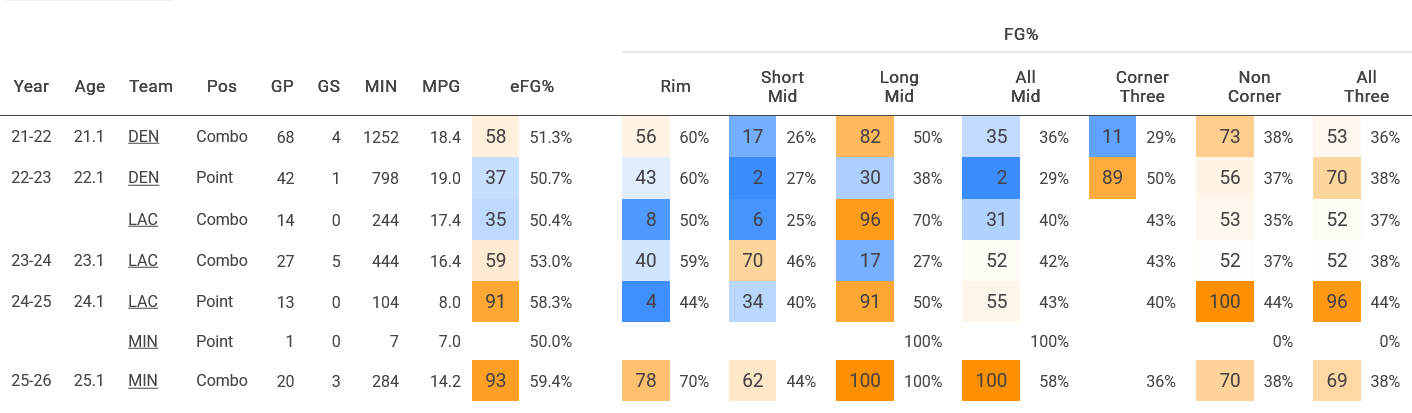
According to Cleaning the Glass, Hyland has shooting splits of 46.5% (47 of 101) from the field and 38% (26 of 69) from three-point range. Hyland has relied heavily on his three-point prowess as a scoring threat, holding a .683 three-point attempt rate (3PAr). A number that is not far off from his career average .594 3PAr.
It’s a limited sample, but Hyland has had an outlier start to the season on 2P FG’s.
In Hyland’s first four NBA seasons, he shot 58% (145 of 250) at the rim and 35.4% (107 of 302) on non-rim 2P FGA. Cumulatively, according to Cleaning the Glass, Hyland shot 45.7% (252 of 552) on 2P FGA over his 2,849 non-garbage time minutes to start his career.
284 minutes this season is nowhere close to 2,849. However, Hyland is shooting 14/20 at the rim this season and 7 of 12 on non-rim 2P FG’s for a total of 65.6% (21 of 32) on 2P FGA.
Hyland’s 2P success will be something to monitor as the season continues. Despite the small sample, he has done a good job of picking his spots.
However, Hyland’s true value has been in Minnesota’s guard room, and alongside Anthony Edwards, his ability to play on and off the ball.
As a natural point guard, Hyland can initiate actions for Minnesota and fill one of their biggest off-season needs. Hyland can also spot up a pass away from Edwards, or relocate across the perimeter to give teammates an outlet.
This multifaceted ability has allowed Hyland to shoot 12 of 30 (40%) on pull-up threes and 16 of 44 (36.4%) on catch-and-shoot threes.
Hyland’s willingness to fire from beyond the arc has been a bright spot for Minnesota’s guard room, which features a more passive Mike Conley and timid Rob Dillingham.
Defensively, Hyland isn’t a stopper, but his improved effort, matched with his 6’9.25” wingspan, allows him to hold his own.
In short, Tim Connelly buying a lottery ticket on Hyland’s dwindling NBA career is looking like an impactful move around the margins. Second-year draftees Rob Dillingham and TJ Shannon haven’t made a significant impact this year. However, what Hyland has been able to capture has been exactly what they have needed in Alexander-Walker’s absence.
Time will tell if Bones Hyland can be a similar development project to Alexander-Walker. Still, the scoring punch and change in playstyle within Minnesota’s guard room on a minimum contract has already begun to pay dividends.